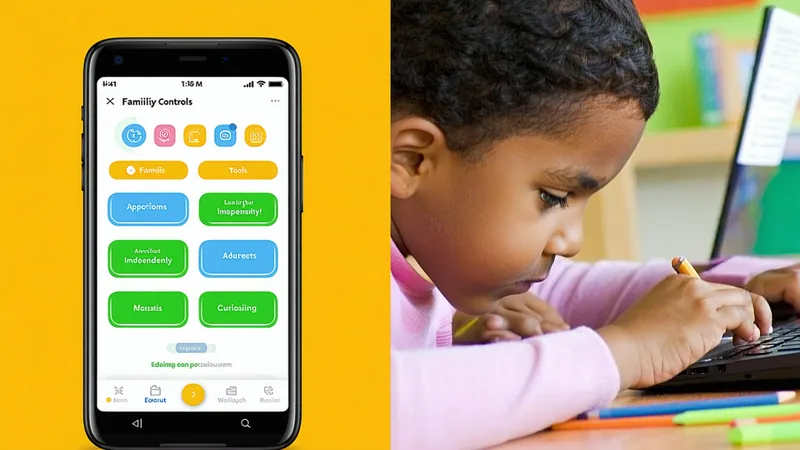
There's a debate in digital parenting circles that sometimes gets framed as a binary: parental controls versus digital literacy education. On one side: the argument that the internet is genuinely dangerous, especially for young children, and that tools to limit, filter, and monitor are necessary and responsible. On the other side: the argument that controls breed dependence, that monitored kids never develop judgment, and that the real solution is education and open conversation.
Both sides make valid points. Both sides, when taken to their extreme, produce bad outcomes. And the families who navigate digital parenting most successfully aren't picking one approach — they're using both, deliberately and in proportion to their child's age and readiness.
What Controls Actually Do (and Don't Do)
Parental controls — screen time limits, content filters, app blocklists, location sharing — do one thing well: they shape the environment your child operates in. They reduce accidental exposure to genuinely harmful content. They create structural constraints that don't require a child to exercise willpower every time they pick up a device. They give parents a layer of visibility that, used thoughtfully, can open conversations rather than replacing them.
What controls don't do: they don't teach judgment. A child who's never been exposed to questionable content because it was always filtered hasn't learned how to evaluate content — they've simply been shielded from needing to. When that shield isn't present (at a friend's house, on a school device, eventually on their own unrestricted phone), they're navigating without practice.
There's also the circumvention problem. Research on adolescent behavior consistently finds that high-restriction environments with low communication produce the highest rates of rule-circumvention. A 14-year-old with a heavily monitored phone and a parent who never explains the reasoning will find a VPN, a secondary account, or a friend's device. The controls didn't fail — they were never going to be sufficient on their own.
What Digital Literacy Education Does (and Doesn't Do)
Digital literacy education — teaching kids how to evaluate sources, recognize manipulation, protect their privacy, communicate responsibly online, and regulate their own use — develops the judgment that controls can't install. These are skills that work regardless of what platform the child is on, what filter is active, or who's watching. They're portable in a way that app-specific controls aren't.
Common Sense Media, whose research on children's media use is among the most rigorous available, consistently emphasizes that skills-based digital education produces better long-term outcomes than restriction alone — particularly in the areas of recognizing misinformation and understanding privacy trade-offs.
But here's the catch: digital literacy education without any structural scaffolding asks a lot of children. Teaching a 9-year-old to evaluate YouTube content for credibility is genuinely valuable — but it doesn't address the fact that YouTube's recommendation algorithm is specifically designed to maximize engagement, not to surface credible content for children. Education helps children make better choices; it doesn't change the architecture they're making choices within.
A Practical Age-Based Framework for Using Both
The right balance between controls and education shifts significantly across developmental stages.
Ages 5–9: More controls, foundational literacy concepts. Young children need a curated environment — appropriate allowlists, content filters tuned for their age, clear screen-time structure. They don't yet have the cognitive development to apply complex judgment consistently, and the digital literacy education at this age is appropriately foundational: what information we keep private, the pause before sharing, the difference between real and pretend online. Controls carry most of the protective weight here; education plants seeds.
Ages 10–13: Graduated controls, active literacy practice. This is the transition zone. Controls remain important — especially around content categories, app store access, and communication platforms — but they should begin to loosen in proportion to demonstrated responsibility. A 12-year-old who has handled a smartphone access agreement for six months with integrity has earned some expansion. Digital literacy education becomes more active: source evaluation, understanding privacy settings, recognizing when an online interaction feels off.
Ages 14+: Minimized controls, practiced autonomy. By high school, the goal is a teenager who regulates themselves — not because controls are gone, but because they've internalized the judgment that controls were scaffolding for. Some baseline filters remain appropriate (explicit content blocking, for example). But the primary work at this stage is communication and trust: a teenager who talks to their parent when something concerning happens online, because they know the response will be support rather than punishment.
The False Choice in the Debate
Parents sometimes worry that using parental controls signals to their child that they don't trust them. This concern is worth taking seriously — and addressing directly with the child. There's a meaningful difference between "I don't trust you" and "I'm helping maintain an environment that makes good choices easier." A child who understands that distinction is less likely to experience oversight as accusation.
Similarly, the argument that "education is enough" underestimates how genuinely difficult it is for a developing brain to consistently apply learned judgment against algorithmically optimized platforms designed by teams of engineers. We wouldn't tell a 10-year-old that they should be able to resist the pull of a dessert buffet through willpower alone — we'd also make different food available and limit how often they encounter the buffet. Controls are the dessert buffet management. Education is building the healthy relationship with food that lasts a lifetime.
The Conversation That Ties It Together
The mechanism that makes both controls and education effective is the same: ongoing, honest conversation between parent and child about digital life. Controls that are explained — "here's what's filtered, here's why" — are accepted and sometimes respected. Controls imposed silently are resented and circumvented. Education delivered as lectures is ignored; education embedded in genuine curiosity about a child's digital experience lands and sticks.
A useful check-in conversation for parents using both approaches:
"I want to review our setup. Here's what I have in place on your device right now. Does anything feel wrong, too restrictive, or like it's blocking something legitimate? I'm also curious — is there anything online lately that felt off or confusing? Not in trouble, just curious."
The review serves multiple purposes: it treats the child as a collaborator in the process, it surfaces false positives (legitimate content that's being blocked), it opens the door to the harder conversations, and it demonstrates that the controls are tools, not surveillance — subject to discussion and adjustment as the child grows.
Parental controls and digital literacy aren't competing philosophies. They're complementary tools that, used together with ongoing conversation, build something neither can achieve alone: a child who is both protected during the years they need protection and genuinely prepared for the years they won't have it.