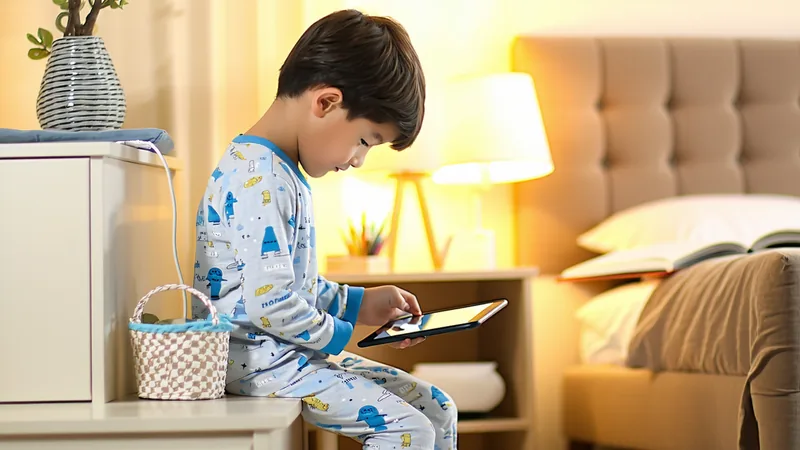
Ask any parent what they wish they'd done differently with their kids and devices, and bedtime comes up constantly. The phone is in the room. They're texting at midnight. They say they're not using it, but the glow under the door suggests otherwise. The argument happens every night, and you're exhausted by it.
The good news is that the research on this is unusually consistent — and it points to solutions that work better than willpower-based rules. The bad news is that those solutions require some structural changes that feel inconvenient at first. But once they're in place, the nightly negotiation mostly disappears.
What the Research Says About Devices and Sleep
Sleep science has become increasingly specific about the mechanisms by which screens disrupt children's sleep. There are two main effects worth understanding:
The first is the blue light problem. Screens emit short-wavelength blue light that signals the brain to suppress melatonin production — the hormone that tells the body it's time to sleep. Research published in Sleep Medicine Reviews found that evening screen exposure delays melatonin onset by 30–90 minutes in adolescents, pushing sleep timing later in a population already biologically predisposed to late sleep schedules. The result: a teenager who "can't fall asleep" at 10pm after an hour on their phone isn't being dramatic — their body chemistry has been genuinely disrupted.
The second effect is cognitive arousal. Content that's emotionally engaging — social media, competitive games, intense YouTube videos — keeps the brain in a state that's physiologically incompatible with sleep onset. The brain needs a deceleration period before sleep, and engaging content of any kind works against that. This matters as much for elementary-age children as it does for teenagers.
A 2020 analysis in JAMA Pediatrics, reviewing data across multiple studies, found that children with devices in their bedrooms slept an average of 20–30 fewer minutes per night than those without — and reported significantly higher rates of daytime sleepiness. The bedroom device question is where the evidence is clearest and the intervention is most straightforward.
The Bedroom Charging Station: Structural, Not Willpower
The single most effective bedtime device strategy is also the least popular with kids: phones and tablets charge outside the bedroom overnight. Not "you should put your phone away at bedtime." Not "phones off by 9pm." The physical device is not in the room while the child is sleeping.
This works because it's structural rather than willpower-based. A rule that says "you should stop using your phone" at bedtime asks a child to exercise self-restraint against something designed by engineers to be maximally engaging. A charging station in the hallway or kitchen simply removes the option. The child isn't resisting temptation every night — the temptation isn't present.
The predictable pushback: "But I use it as my alarm clock." This is easily solved with a $10 standalone alarm clock. The alarm clock excuse is, in many families, the final line of defense against the charging station rule — and it's worth naming that directly with your teenager: "I know. Here's an alarm clock. We're still moving the phone."
For younger children (under 10), this rule is typically easy to implement because parents have more physical control over devices. The time to establish it is before the child becomes emotionally invested in having the device in their room — which means ideally from the first time they have a device at all.
Building the Wind-Down Routine: What Should Replace Screens
Telling kids to stop using screens without offering something to do instead doesn't work. The wind-down period — the 30–60 minutes before sleep — needs to be filled with something, and "nothing" isn't actually available as an option for most children and teenagers. The question is what that something will be.
What the sleep research supports: activities that are calm, familiar, and relatively low-stimulation. Reading physical books is the gold standard — there's consistent evidence that reading before bed is associated with faster sleep onset and better sleep quality, likely because it provides engagement without the arousal-inducing properties of screen content. Audiobooks or podcasts through a non-phone device (a dedicated speaker, for example) work well for children who resist reading. Conversation, journaling, and low-key music are also genuinely effective.
For elementary-age children, the routine itself is the anchor. A 7-year-old who has done "bath, pajamas, story, lights out" in the same order for years will move through that sequence with almost no resistance — the routine carries the behavior. When screens enter that routine (a bedtime YouTube video, a pre-sleep iPad game), they disrupt the signal function of the sequence. The child's brain isn't winding down; it's gearing up.
A Sample Conversation for Transitioning to the New Routine
If you're shifting from a no-rule household to a bedroom-charging household, the transition conversation matters. Springing this change without notice creates predictable resistance. A more effective approach:
"I want to make a change to how we handle phones and tablets at bedtime. I've been reading about how screens affect sleep, and I think we've all been feeling the effects. Starting this weekend, phones are going to charge in the kitchen overnight — that includes mine and your dad's, so this is a family rule, not just a rule for you. I know it might feel annoying for a while. Let's try it for two weeks and see if anyone sleeps better. Deal?"
Two elements worth noting: the two-week trial framing makes it feel temporary and testable, not permanent and punitive. And applying the rule to parents as well signals that this is a family values change, not an authority-over-child rule. Parents who follow their own bedtime device rules are significantly more likely to have children who accept them.
The Harder Conversation: Teenagers and Autonomy
For teenagers, the bedroom charging station can feel like a violation of their autonomy in a way it doesn't for younger children. Adolescent development is fundamentally about establishing independence, and a 15-year-old whose phone is taken away at 9pm may experience it as much more than an inconvenience.
The most effective approach with teenagers is honest reasoning rather than authority: "Here's what I know about sleep and screens. Here's what I've noticed about your sleep and mood. Here's the change I want to make, and here's why. What would make this feel less like punishment and more like a reasonable health decision?" A teenager who understands the physiological mechanism is more likely to buy in — even if they don't say so — than one who just hears "no phones after 9."
We're not saying teenagers will thank you. They probably won't, at least not immediately. But the goal isn't gratitude — it's a habit that protects their sleep quality during a developmental period when sleep is particularly important for brain consolidation, mood regulation, and learning. A 14-year-old's brain is doing more sleep-dependent work than at almost any other point in life. The stakes are genuinely high.
Bedtime Mode vs. Parental Willpower
One practical advantage of using parental control tools is that the bedtime rule can be automated rather than enforced nightly by an exhausted parent. A setting that locks access to apps after 9pm shifts the enforcement from "mom says no" to "the phone literally won't do it." That shift matters psychologically — the child's frustration is directed at the system, not at you, and the nightly argument largely dissolves.
Automation doesn't replace the bedtime conversation. Children and teenagers who understand why the limit exists — and have been part of setting it — accept automated enforcement much more readily than those who feel it was imposed without explanation. The technology supports the relationship; it doesn't substitute for it.